
What sound does a dog make? well it definitely isn’t *honk*. When we encounter odd sounds when our fur friends are breathing more often than not there is an issue (yea that includes our smoosh faced friends *darth vader*). When there is a honk one thing that comes top of mind is a collapsing trachea. a what? a collapsing trachea. And when it’s collapsing it is no joke.
The trachea, is your pet’s windpipe, their breathe tube. Breathing in general is pretty great, so when something isn’t right, it’s something that should be addressed ASAP. The trachea is made up of cartilage rings and muscle. The rings are not complete but rather a c-shape with the mouth of the c pointing up towards the spine. The muscle (trachealis muscle) runs along the top of the open part of these rings.
Sometimes these rings get a bit ‘lazy’, they lose some of their stiffness. As the rings lose their structure the muscle across the top begins to stretch. When this happens the changes in pressure along the trachea cause the collapse and poor/altered air flow as it pulls the trachealis muscle down into the windpipe. When this happens exactly depends where the collapse is happening. If it is occurring in the trachea within the chest the collapse happens on exhalation. If the collapse is located within the trachea in the neck it will occur on inhalation. This difference is due to pressure differences, yay science!
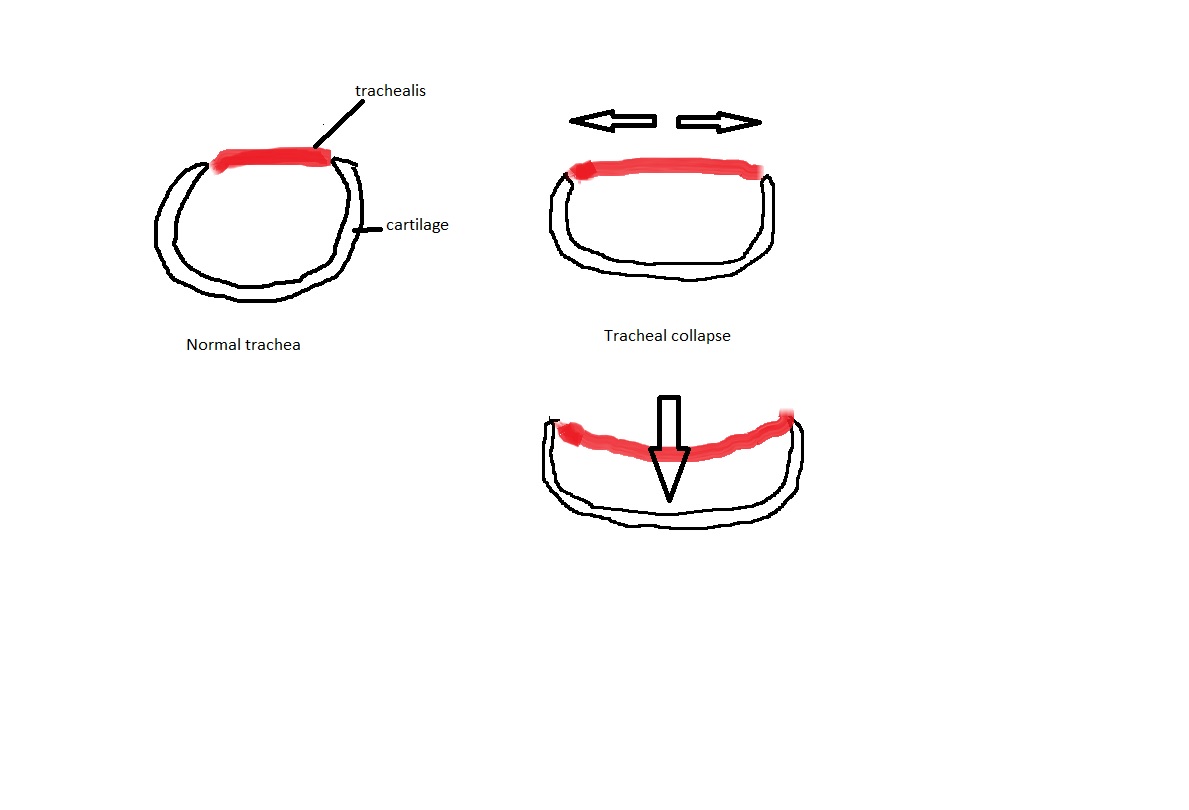
In either case, as that trachealis muscle starts to be sucked into the tracheal lumen (that’s the air space) it irritates the tissue inside causing coughing. That dry cough has often been described as a ‘goose honk’. As the animal struggles to breathe properly they become anxious which increases their breathing and increases the coughing and thus starts the vicious cycle. Further to that, tracheal inflammation will cause further weakening of the rings and worsening collapse.
Most often it is our toy breeds that have this issue. Some dogs with collapsing trachea may not even show signs unless they develop a second condition that exacerbates the issue. Obesity, respiratory disease, high amounts of respiratory irritants (smoking/dust), and heart disease are all risk factors. Collapsing trachea is diagnosed through clinical exam as well as x-rays and/or fluoroscopy. Once diagnosed the condition is managed (not cured), mild cases are often treated medically with cough suppressants, anti-inflammatory drugs, and airway dilators. Sometimes, when the condition is severe enough, surgical intervention is required. The current preferred method of most specialists is the use of a self expanding stent that keeps the airway open.
Interesting fact- there has been research showing that oxygen deprivation from a collapsing trachea is associated with liver disease (patients with collapsing trachea who were surgically repaired had improvements in their liver function tests). From this it has been suggested that patients being medically managed for collapsing trachea consider having regular blood work to assess liver function in case they need medical support of that as well!
If you are suspicious that your pet may have issues breathing always bring them in to your vet! honking=no good
 PET Pulse
You must be logged in to post a comment.